New York Overtime Pay: Salary, Remote Work, and Misclassification
New York employees are often surprised to learn that a job title, a salary, or working from home does not automatically eliminate the right to overtime pay. Wage-and-hour rules depend on the actual work performed, how time is tracked, the industry, and other facts unique to the job. If you believe you were not paid for all hours worked, a case-specific review can help clarify your options.
Does Being Paid a Salary Mean I Am Exempt From Overtime?
No. Being paid a salary does not, by itself, mean an employee is exempt from overtime. Employers sometimes use salary pay as if it settles the question, but the analysis is more detailed. The employee’s primary duties, degree of independent authority, job responsibilities, and the applicable wage-and-hour rules all may matter.
For example, a job title such as manager, administrator, or supervisor is not necessarily decisive. An employee who spends most of the workweek performing the same production, service, sales, or support tasks as other employees may not be exempt simply because the employer assigned a managerial-sounding title.
L & D Law P.C. reviews the real day-to-day work behind a title and pay arrangement. That practical review is especially important when an employer has classified someone as exempt without closely examining the duties of the position.
When Is Overtime Generally Owed in New York?
Most nonexempt employees generally must receive overtime pay after working more than 40 hours in a workweek. In many situations, overtime is calculated at a higher rate of pay, but the governing rules can vary based on the employee’s classification, compensation structure, occupation, and industry.
Not every long day creates overtime on its own. The usual focus is the total number of qualifying hours worked during the employer’s defined workweek. That means an employee who works several extended shifts may have an overtime claim if the weekly total exceeds the applicable threshold, even if the employer did not specifically approve every extra hour.
There are important exceptions and industry-specific rules, so employees should avoid assuming that every situation has the same answer. A New York wage-and-hour review should look at schedules, pay records, job duties, and the employer’s policies before reaching a conclusion.
What Is Off-the-Clock Work?
Off-the-clock work is work an employee performs without being paid for that time. It can happen when an employer expects, permits, or knows that employees are completing job duties before clocking in, after clocking out, or during unpaid breaks.
Common examples include opening or closing a workplace, loading equipment, attending required briefings, finishing reports after a shift, responding to customer requests, or correcting work after a timekeeping system has ended the shift. A policy that says overtime must be approved does not necessarily allow an employer to withhold pay for work it knew or should have known was being performed.
The key question is often whether the time was truly work time and whether the employer had reason to know it was happening. Documentation can make a meaningful difference in answering those questions.
Can Remote Work, Emails, Preparation Time, or Missed Meal Periods Count as Work Time?
They can. Remote work does not become unpaid simply because it happened at home, on a phone, or outside a traditional office. Reading and answering work emails, taking calls, updating systems, joining required virtual meetings, or performing assigned tasks after hours may count as compensable work time depending on the circumstances.
Preparation time may also matter. Employees who must set up a workstation, log into required programs, gather tools, complete safety procedures, or prepare materials before they can begin their principal duties may be working during some or all of that time. The answer depends on what the employer requires and how closely the activity relates to the job.
Meal periods deserve the same careful attention. A break that is regularly interrupted by calls, customer needs, required monitoring, or work assignments may not function as a fully relieved meal period. Missing or interrupted breaks can raise wage-and-hour concerns, particularly when employees are expected to remain available and keep working.
Workplace discrimination, sexual harassment, or severance concerns can sometimes arise alongside unpaid-wage issues. L & D Law P.C. can assess how the facts fit together rather than treating each workplace problem in isolation.
What Records Should an Employee Keep?
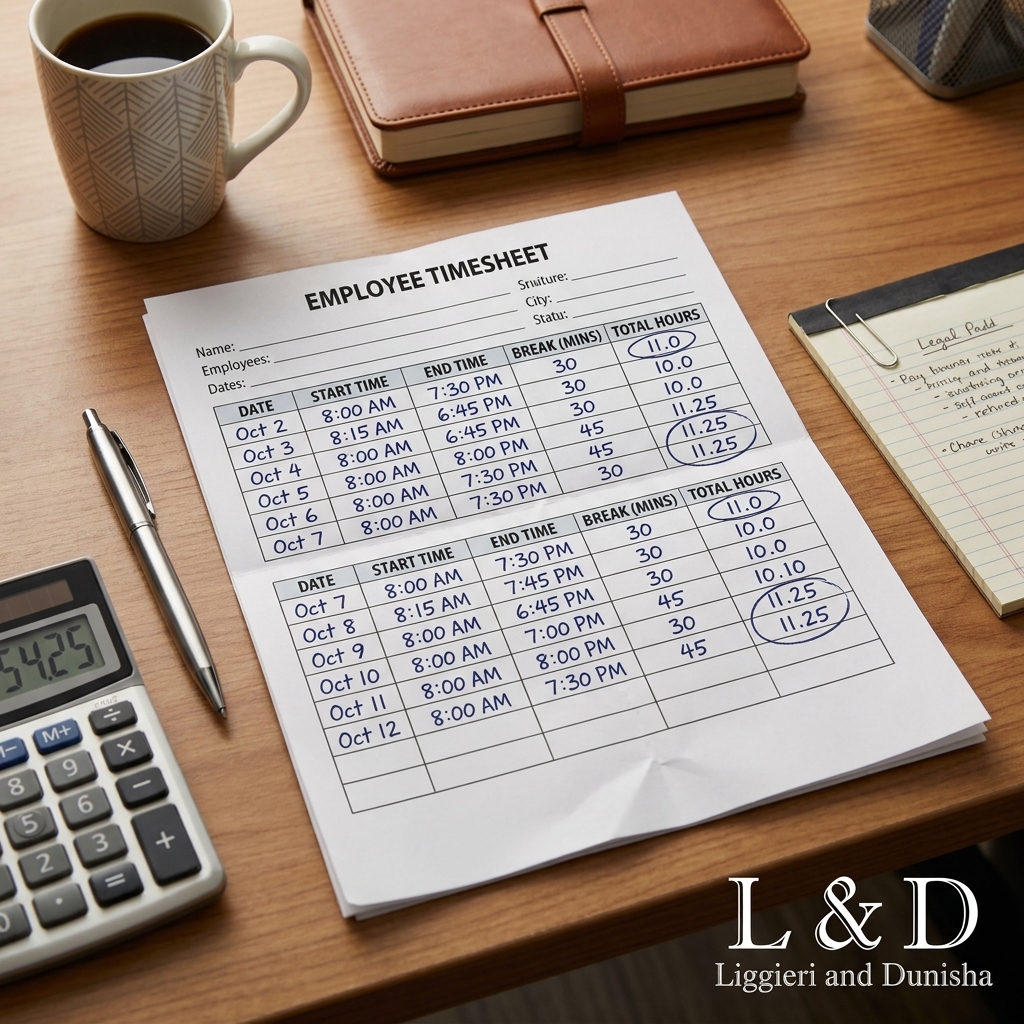
Employees do not need perfect records to ask questions about unpaid wages, but organized information can be helpful. Keep personal notes of dates, start and end times, missed or interrupted breaks, after-hours calls or emails, and tasks completed outside scheduled hours.
- Pay stubs, wage notices, and direct-deposit records
- Work schedules, timecards, calendar entries, and shift-change messages
- Emails, text messages, chat logs, and instructions showing after-hours work
- Job descriptions, offer letters, employee handbooks, and classification notices
- Notes about who assigned the work, who observed it, and whether concerns were reported
Use personal accounts and devices only in a lawful, appropriate way, and do not take confidential company information that you are not entitled to possess. A knowledgeable NYC attorney can help identify the records that are most relevant to a potential claim.
What If an Employer Misclassifies Someone as an Independent Contractor or Exempt Employee?
Misclassification can affect overtime, minimum-wage protections, recordkeeping, and other workplace rights. Calling a worker an independent contractor does not automatically make that classification correct. The working relationship matters, including the level of control the business exercises, how the work is integrated into its operations, and the worker’s actual independence.
Similarly, labeling an employee as exempt does not end the inquiry. Employers may make mistakes when applying exemptions, particularly where the employee’s assigned duties differ from the formal job description. A careful review should focus on substance, not just the label used on a paycheck, contract, or onboarding form.
L & D Law P.C. is a New York law firm that evaluates wage-and-hour concerns with attention to the facts of each work arrangement. Whether you were paid a salary, received a 1099 form, or held a supervisory title, it is worth understanding whether the classification reflects the work you actually performed.
Can an Employer Retaliate for Raising Wage Concerns?
Employers may not retaliate against employees for raising wage concerns or seeking information about their pay rights. Retaliation can take different forms, including reduced hours, undesirable schedule changes, threats, discipline, demotion, termination, or other treatment that appears connected to an employee’s complaint or request for unpaid wages.
Not every workplace action is retaliation, but timing and context can be important. Save communications related to your concern, note who was involved, and document any changes that occurred after you spoke up. If the circumstances also involve workplace discrimination or sexual harassment, those details may be relevant to a broader employment-law assessment.
Why Is a Case-Specific Review Important?
Wage-and-hour disputes are rarely resolved by one simple rule. A complete review may involve payroll practices, timekeeping systems, job duties, remote-work expectations, meal-period practices, and the employer’s knowledge of unrecorded work. Industry rules and exemptions are fact-specific, which is why broad assumptions can be misleading.
L & D Law P.C. serves employees throughout New York who need a clear, compassionate assessment of workplace concerns. For workers seeking an Albanian attorney in New York to discuss unpaid wages, employment discrimination, or other difficult workplace issues, the firm offers attentive, fact-focused advocacy. The firm also values referrals from attorneys and past clients who know someone facing unpaid wage issues, employment discrimination, or another difficult workplace situation.
FAQ
Can I receive overtime if I am paid a fixed weekly salary?
Possibly. A fixed salary alone does not determine overtime eligibility. The applicable rules and your actual job duties must be evaluated to determine whether you are properly classified as exempt or nonexempt.
Does my employer have to pay me for after-hours emails?
If you are nonexempt and the email work is required, permitted, or known by your employer, that time may be compensable. The amount of time, frequency, nature of the messages, and employer expectations can all be relevant.
What if my manager tells me not to record overtime?
That instruction may be significant, especially if you were still expected to complete the work. Keep a contemporaneous record of the request, the hours worked, and related messages or witnesses, then seek a case-specific review.
Can I raise a wage concern without being fired?
Employees have protections against retaliation for raising wage concerns. If you experience a negative job action after speaking up, document what happened and when it occurred. An attorney can evaluate whether the facts may support a retaliation claim.
Should I wait until I leave my job before seeking legal advice?
Not necessarily. Speaking with an attorney does not require you to quit your job, and earlier guidance may help you preserve records and understand your options. Because deadlines and facts can matter, a timely, individualized discussion is often the best next step.